Money Matters
Currency And Exchange
The United Kingdom’s unit of currency is the British pound. France’s unit of currency is the Euro.
You can obtain the current exchange rate by using an online currency converter such as XE.
Foreign currency can easily be exchanged at banks and ATMs, some hotels, and exchange kiosks, which are found at international airports and most city centers.
Credit Cards
Major credit cards are accepted throughout the United Kingdom and France, with the exception of some small towns and villages. However, even in large cities, some small cafés, shops, and street vendors may only accept cash payment.
When traveling abroad, it is highly recommended that you notify your bank and credit card companies that you will be traveling to avoid a possible ‘freeze’ on your account.
How Much to Bring
We do not have a suggested amount, as everyone has different spending habits. Please take the following into consideration when determining the amount that is most suitable for your spending habits:
- Do you use credit cards readily or will you need to rely on cash for the majority of your expenses?
- Do you plan to purchase many souvenirs or gifts?
- How many independent meals are in your itinerary? In England, a casual lunch averages around $15-20, and a nice, but not lavish dinner averages around $45-60. In France, a casual lunch averages around €15-25, and a three course dinner averages around €35+.
- How much will you spend on alcoholic beverages (usually not included with meals)?
- How much will you need for gratuities?
Gratuity and Tipping Guidelines
When you are on your own, the following guidelines will be useful:
- Restaurants:
- England: a tip of around 10% is expected if you order at your table. If a “service charge” or “optional charge” is included on a bill, an additional tip is not expected.
- France: most restaurants include a service fee (service compris) in the price of the meal, as indicated on the bill for the meal or the menu. If service was exceptional, round up the bill or leave additional change. In the rare instance when service is not included, a 10% tip is appropriate.
- Taxis:
- England and France: although a tip is not expected, it is customary to round up to the nearest pound or euro.
- Hotel staff (if you are staying beyond the tour dates):
- England: £1 – £2 per night for housekeeping and £1 – £2 per bag for porters.
- France: €1 – €2 per night for housekeeping and €2 per bag for porters.
Gratuities for your Smithsonian Journeys Expert, Travel Director, local guides, and drivers are included in the journey price. Please note that the Smithsonian Journeys Expert and Travel Director do not expect and will not accept tips.
Bank Hours
In England, banks are usually open from 9:30 a.m. to 3:30 p.m. and 3:00 p.m. to 5:00 p.m., Monday through Friday in both countries. In France, banks are usually open from 8:30 a.m. to 5:30 p.m. Monday through Friday, but some locations may close during lunch. In both countries, banks typically close early on Saturdays and are closed on Sundays. To avoid long lines, it is best to make use of ATMs.
VAT Information
In England, the standard VAT rate is 20%. For visitors who live outside the UK, you are permitted to claim back VAT tax. While purchasing items in the U.K., inform the retailer that you need a VAT form. They will likely ask you to complete a form as well as provide your passport. At the end of your trip, refund requests can be made at refund points at London Heathrow, though you will have to connect from your departure from Charles de Gaulle .
In France, retail purchases over €175 are eligible for a VAT refund. In order to claim the VAT, please ask for the Detaxe form before leaving the store and keep the original receipts. There are self-service stations at the Charles de Gaulle airport called PABLO machines, which can validate the return.
Staying Connected
Internet Access
Internet is available in a variety of locations, hotels, coffee bars, restaurants, hotels, and airports. Caution is advised when using public Wi-Fi to communicate with others or access personal or sensitive information. Complimentary internet access is available at your accommodations.
Phone Service
You can stay connected by phone via the following methods:
- Calling from Hotels – Phone calls to the United States can be made from the hotels. To call the United States, dial 001 followed by the area code and phone number. Please keep in mind, call rates charged by hotels can be very high, especially when calling internationally.
- Carrier Plan – You will need an international plan to make cell phone calls in England and France. We advise you check your cell phone provider to inquire about its international calling plans and roaming charges. These plans usually charge per person, per day.
- Wi-Fi Calling Applications – If you prefer not to get an international plan, we recommend applications such as WhatsApp or Skype, which allow users to send messages and video chat for free only between other WhatsApp and Skype users, as long as you are connected to Wi-Fi. iPhone users can also iMessage and FaceTime other iPhone users while connected to Wi-Fi. For additional information, please contact your Guest Services Advisor.
Electricity
The electrical current in England and France is 230 volts. Most common appliances, such as phones, laptops, and cameras, are dual voltage and will convert voltage automatically. If your appliances are not dual voltage, you may need a voltage converter (Please note these common devices which are not dual voltage: hair dryers, curling irons and hair straighteners, electric toothbrushes, and electric razors).
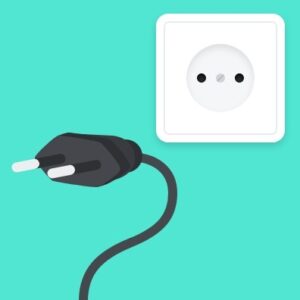
For all devices, you will need a plug converter to accommodate English and French outlets, which are shown below.
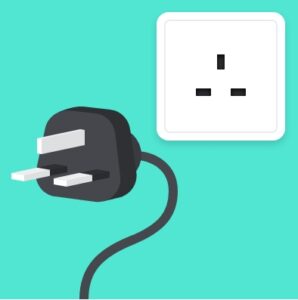
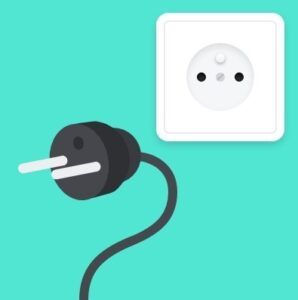
Type G Type C Type E
Time
While in England, you will be in the Greenwich Mean Time. The time change between U.S. Time Zones during your trip, is as follows:
- Eastern Daylight Time: 5 Hours Behind
- Central Daylight Time: 6 Hours Behind
- Mountain Daylight Time: 7 Hours Behind
- Pacific Daylight Time: 8 Hours Behind
- Aleutian Daylight Time: 10 Hours Behind
While in France, you will be in Central European Summer Time.The time change between U.S. Time Zones during your trip, is as follows:
- Eastern Daylight Time: 6 Hours Behind
- Central Daylight Time: 7 Hours Behind
- Mountain Daylight Time: 8 Hours Behind
- Pacific Daylight Time: 9 Hours Behind
- Aleutian Daylight Time: 11 Hours Behind